There are many structures in mathematics that turn up in different forms in a variety of contexts. The concepts of Duality or Quotients can be found throughout the mathematical landscape, but there is one which is fundamental to many areas. From Category Theory to Partial Differential Equations, limits are defined everywhere, but often with different definitions, so what is a limit? I’d recommend you read the start of my Baking Topological Doughnut post for a refresher on some basic topology, as we’ll be using open neighbourhoods here.
So, what actually is a limit?
A limit, in the most general sense, can be though of as the object which fills in some gap, so you might classically think of a sequence limit as filling in the gap at the end of the infinite sequence

But this can be too restrictive, we can view a limit over the reals
![\[\lim_{x \to a} f(x)\]](https://blog.samuelgill.net/wp-content/ql-cache/quicklatex.com-28f8fd36e275b701bfac11dc07e80786_l3.png "Rendered by QuickLaTeX.com")
as the gap at the end of a function, as below.
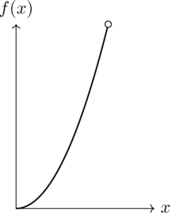
We can always view the first case as the second, by using step functions, but this is too forced. We would like to find some way to extend the second case to the first.
Let’s look at our second example above, for the sake of our notation, we want to place  at infinity. How can we do this? We just change variables, we can set
![\[x = a(1-e^{-y}) .\]](https://blog.samuelgill.net/wp-content/ql-cache/quicklatex.com-be3fb221fdcf34e9c9753d75701c34a7_l3.png "Rendered by QuickLaTeX.com")
Then as  ,
,  . Then we view
  as a function of
  instead of
  .
.
What’s ne(x)t?
In this view, we can find the similarity between our two limits. They both feature two sets,  and
and  , and some way to tell when a value is later in the set than another, an order
  . An order here is a binary relation (Think
  ) which satisfies the following properties.
- Reflexive,
 for all
  .
. - Transitive, if
 and
and  , then
  .
. - Antisymmetric, and
 , then
  .
.
These conditions are actually too strong, we can actually work with orders that are not antisymmetric, we call such relations preorders.
Let  be a set with some preorder , we call a directed set if for any two elements
  , there is some larger
  such that
  . This might seem trivial, but note that removing antisymmetry opens us up to the possibility that we can find two elements
  such that
  and
and  .
.
Then we can define a “net” in  to be a way of indexing a list of elements in by . This is defined as a function
  . We often denote
  as
as  .
.
So how do we define the limit of a net? We say that for a subset  ,
,  is eventually in
  if there exists some
  such that for every
  with
with  ,
,  . If for all open neighbourhoods of a point (the collection of open sets containing , think of this as a circle, or a small interval containing a point), our net is eventually in that region, then is our limit.
It should be noted that this point might not be unique, however if we pick our to be what’s called a “Hausdorff space”, then it will be. Practically everything we will look at will be, so lets put aside this worry for now.
In our filling in the gap concept from the start, then we can view our gap as at the end of our net, however due to the variety of types of nets, this becomes harder to visualise. In some simpler cases, we can view our net as a graph, like below, and the limit would be the point at the end of all the chains.
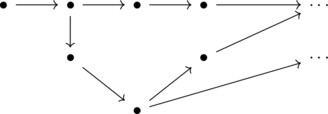
The more abstract nature of these nets can make them harder to visualise, there is another method though.
Filtering the approach
There are many alternative ways to view this limit, another equal way is through the so called “filter”. In the previous method, we picked a series of points and got a limit, we can alternatively pick a series of sets in , and consider their limit.
To do this, we use the concept of a filter. A filter,  is a collection of subsets of a space , such that the following hold,
- Upward Closed, if
 and
and  , then
  .
. - Closed under finite intersections, if
 , then
  . In particular, we denote the intersection of
  elements to be , so this implies that
  .
. - The empty set
 is not in .
We can think of filters as the “big” subsets of a space. In this sense, the conditions above can be thought of as the following,
- If is a big set, then any set bigger than (i.e. containing as a subset) is also a big set.
- If
 are big sets, then their intersection is also big.
 - The empty set is not big.
So how do find a limit of these? The key fact to notice is the set of open neighbourhoods of a point form a filter, let’s call this filter  . We then say some filter converges to a point if
  , namely every subset in is also in . This again raises questions of whether this limit is unique, and again this may not be the case, but working with “Hausdorff” spaces, we again get uniqueness.
Now that we have these two different notions of a limit, how do we get that they coincide? Let’s do it formally.
First we will show that a net limit can be written as a filter limit. Let our net be such that it converges to . Let have the preorder , consider the sets  . We then take the filter generated by
  , namely all the sets which can be made of intersections and enlargements of the
  . We can then see that for an open neighbourhood
  of , as is eventually in , there is some such that
  , thus is in the filter, thus the filter converges to .
For the reverse case, consider the filter , we can take to be the space
![\[A = \{ (a, x): a \in \mathcal{F}, x \in a\}.\]](https://blog.samuelgill.net/wp-content/ql-cache/quicklatex.com-95ccbff115a1b01b55e8ca21bbc71cbd_l3.png "Rendered by QuickLaTeX.com")
We then define a preorder on by  if
if  . We then take to be the map that sends
  . We won’t show this is a net, but it is. We can also see that for any open neighbourhood of , is an element of the filter, so we can take the element
  to get that the net is eventually in .
Can we go further?
Now that we have these tools, it raises some questions,
- Can we go more general?
- When can we guarantee a limit?
- What if we want to take a limit of other structures, like sets or groups?
Let’s work through these and give some answers.
Generally a Good Idea
There is a way to take the concept of a filter/net limit to more generality. You may have noticed our reference to “open sets” above, this means that we can’t work in a general set as I’ve slightly mislead you to believe. In fact we have to have worked in a topology, this way the concept of an open neighbourhood actually makes sense. We can however weaken the need for a topology to that of the aptly named “Convergence space”.
A Convergence space is a set as well as some relation  from
from  to . Here is the set of filters on . We say converges to if
  . This relation can be anything that satisfies the following properties,
- Centred, The “principal ultrafilter”
 .
. - Monotone (sometimes called Isotone), If
 and , then
  .
. - Directed, If and , then some filter in the intersection
 .
.
If has a topology, then we can have if it does in the sense we defined earlier, this then gives a Convergence space. This is not the only example though, we could also take functions between measure spaces with almost everywhere convergence (convergence pointwise on all but an empty set, although I won’t expand on these), this relates to the measure theory discussed in Probability – Probably a good Idea.
Ultimate Filtering
You may have noticed the word “ultrafilter” above, and wondered what this means. This in fact relates to the second of our questions. An ultrafilter is a filter with one extra property, namely that for any set , either is in the ultrafilter, or it’s compliment is in the ultrafilter. One example of a filter with this property is the so called “principal” ultrafilter defined above. We then may want to find an example of a non principal ultrafilter, this is however harder than you might expect. In fact this requires the axiom of choice, as without choice it is possible that every ultrafilter is principal.
Once we have an ultrafilter , we can ask what limits it can have. It turns out that if our space is compact, then it will always have a limit, unlike the filter case, which might just have a cluster point (a weaker form of a limit point.
This can also be used to prove a key theorem in topology, Tychonoff’s Theorem, that the arbitrary product of compact spaces is compact.
A Category above the Rest
To answer our last question, we must move beyond the realm of topology to the area of category theory. I’d like to delve deeper into this area in much more depth, so I won’t say much here, but we can use the techniques in category theory to define a so called “colimit” or “limit” of objects in a category. A particularly useful case here is that of a direct limit, which can be thought of as us the last element of the sequence below.

A good example is if we take  to be the algebra of
  matrices, where we then have the limit called the CAR algebra, denoted
  .
.
No Responses