There is a common joke among mathematicians that a topologist can not tell the difference between a cup of coffee, and a doughnut, but why is this, and how does one topologically define these structures?
What is a topology?
A topology is a way of looking at subsets of a larger set, using a topology we can qualify certain sets as “open”, or “closed”. In the context of a topology, the idea of an open set is fairly meaningless, a set is open as we just state that it is open. However later on we shall be working in  where we can view open sets through the lens of a metric space, where there is a nice intuition for what we could call open.
One example of this is in  , here open sets
  are such that
![\[ \forall x \in U, \exists \epsilon >0, (x-\epsilon,x+\epsilon) \subseteq U \]](https://blog.samuelgill.net/wp-content/ql-cache/quicklatex.com-e02f6fd5158e9a5afccffe2850fa2bf1_l3.png "Rendered by QuickLaTeX.com")
 of the set , we can find some distance
  such that all the points which are away from are in the set . Here we say the distance between two points
  is given by
 ![\[ d(x,y) = | x - y| \]](https://blog.samuelgill.net/wp-content/ql-cache/quicklatex.com-83b6113b227a9d1a35bd0f0ecc418c53_l3.png "Rendered by QuickLaTeX.com")
via the Euclidean distance you would normally think of.
As a concrete example, in  ,
,  is open as we can always find a region around x no matter how close to the edge we get, on the other hand
 ![[0,1] = \{ x \in \mathbb{R} : 0 \le x \le 1\}](https://blog.samuelgill.net/wp-content/ql-cache/quicklatex.com-7aecd16e1381ab5b5be3f261d75cef09_l3.png "Rendered by QuickLaTeX.com") is not open, as at the edges, no matter how small we make our distance, we will always have some points not in the set.
is not open, as at the edges, no matter how small we make our distance, we will always have some points not in the set.
As a side note, one may think of closed as not open, but this is not true, we say a set is closed if its compliment (All points which are not in the set) is open. However this can lead to the cases where a set is neither open or closed (We could think about  where there is no ball around
  in the set, and no ball around
  in the compliment), or where the set is both open and closed (We could look at the full space , as it’s open trivially, and its compliment is the empty set, so has a ball around all it’s elements – for which there are none).
What actually is a topology?
Given a set  , we can define a topology
  as a collection of subsets of which have the following properties.
Given  and
and  with
with  arbitrary, and
  finite, then,
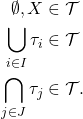
(1) 
But what does this mean?
 tells us that our topology must contain
  , the empty set and , the full space.
 tells us that an arbitrary union of sets in our topology must remain in our topology
 tells us that a finite intersection of sets in our topology must remain in our topology.
We can then call the elements of our topology the open sets.
An exercise to the reader would be to show that the definition we gave of open sets in the first section obey all these rules. One could also show that we can’t extend this to an arbitrary intersection, one can find an infinite number of sets such that their intersection is not in the topology.
Continuous maps
We will also use the concept of a continuous map. A map is a function from one space to another, one could for instance have  given by
  , here map
  maps from
  to .
to .
Now there are a variety of ways to define a continuous map, in a topology the only way we can abstractly define it is to say the preimage of open sets are open. So if  , then is continuous if
  open in Y, then
  is then open in X. This is a very useful definition for proofs, however it is not very useful to visualise, so again we can find an equivalent definition in a metric space.
Here we can say that is continuous at  if
if  ,
,  such that
  with
with  implies that
  . We can think of this as for each ball around the point
  , we can find some region around such that all points in this second region land in the first ball when you apply .
Quotient Spaces
Now we can start to construct our doughnut. To do this we will use the concept of a quotient space.
Lets start with our topological space  . We now want to get an equivalence relation on the space, I have defined these before, but for a quick recap, we can think of these as a quality between two elements. We can then say
  if it’s true (said relates to
  ), a relation is then equivalent if it is reflexive (
 for all ), symmetric (if , then
  ) and transitive (if and
  then
then  ). We can then think of the equivalence class of , written
 ![[x]](https://blog.samuelgill.net/wp-content/ql-cache/quicklatex.com-d405372902b2113f84880d72e26a848d_l3.png "Rendered by QuickLaTeX.com") or
or  , as the set of elements which then relate to .
Lets now have an equivalence relation  on , now let
  denote the set of equivalence classes, we now want to construct a topology on , we do this through the concept of a collapsing map, this is the map
  from to given by
 ![p(x) = [x]](https://blog.samuelgill.net/wp-content/ql-cache/quicklatex.com-40c1c1f7bb6da0486232416ae1b7ff7c_l3.png "Rendered by QuickLaTeX.com") . We then define a topology
. We then define a topology  where
where
![\[U \in \tilde{\mathcal{T}} \Longleftrightarrow p^{-1}(U) \in {\mathcal{T}\]](https://blog.samuelgill.net/wp-content/ql-cache/quicklatex.com-401e5e5ac7b5f23f587358101dbe0f87_l3.png "Rendered by QuickLaTeX.com")
So what does this mean?
We can think of this as any  as a collection of equivalence classes, then
  is then the elements in which are in an equivalence class in . Hence is then open if the collection of elements which are in the equivalence classes of U is open.
Constructing our Doughnut
In order to get an idea of how the above construction works, lets start making our doughnut.
Ingredients
To start making our doughnut, we first need an underlying space, this will be our , and in this case we will consider ![X = [0,1]^2](https://blog.samuelgill.net/wp-content/ql-cache/quicklatex.com-3712e25b7635806d63fb42e46968e22e_l3.png "Rendered by QuickLaTeX.com") , which all pairs of numbers
, which all pairs of numbers  such that
  .
.
We then need a topology on our space , we will do this by saying
![\[ U \in \mathcal{T} \Longleftrightarrow \exists V \subseteq \mathbb{R}^2 \text{ With $V$ Open in the usual sense, and } U = V\cap X\]](https://blog.samuelgill.net/wp-content/ql-cache/quicklatex.com-df7afe3e34461298cd994d33e9bf2d82_l3.png "Rendered by QuickLaTeX.com")
We can think of this as is open in if we can find a region around each point in of points in , note this does not include points that lie outside of ![[0,1]^2](https://blog.samuelgill.net/wp-content/ql-cache/quicklatex.com-3879d97cb8efef41349b68c453dc6552_l3.png "Rendered by QuickLaTeX.com") , as we are only considering those points.
, as we are only considering those points.
Recipe
Now we also need to construct an equivalence relation on this set, in this case we will use that  if either
  and
and  or
or  and or the same with swapping the coordinates, so
  and
and  or and .
We can then picture this by
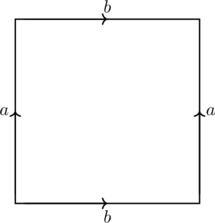
Now, we can visualise the quotient topology as sticking together these lines in such as way as we preserve the direction of the arrows, thus giving…
…our doughnut, we can now see that for any point on the set, we can use our old definition of open, and this further allows us to do some much more in-depth mathematics on this surface, such as differentiation, through the use of a structure called a manifold, which this is an example of. I may cover this further in the future.
One Response
[…] often with different definitions, so what is a limit? I’d recommend you read the start of my Baking Topological Doughnut post for a refresher on some basic topology, as we’ll be using open neighbourhoods […]